

NatHalie Braun Barends was invited to the Kunsthalle Mannheim in spring 2006 to create a permanent, context-specific spatial installation. In July 2006, the artist was recognized for her unique work concept when she was selected for the museum’s “Artist in Residence” program. Conceived as an “Evolving Art Project,” the work, which began during the special exhibition “Full House – Faces of a Collection,” is in a permanent phase of creative development whose “end lies in infinity.”
NatHalie Braun Barends chose the connecting building between the old and new sections of the Kunsthalle as the location for her multimedia and multidimensional light installation, which is both exceptional in terms of both content and technology. The work is located exactly at the center of the multi-story building section, where a daylight hall dating from 1907 stood before the new building was constructed in 1982. With “HHole (for MannHeim),” this architecture is once again filled with light.
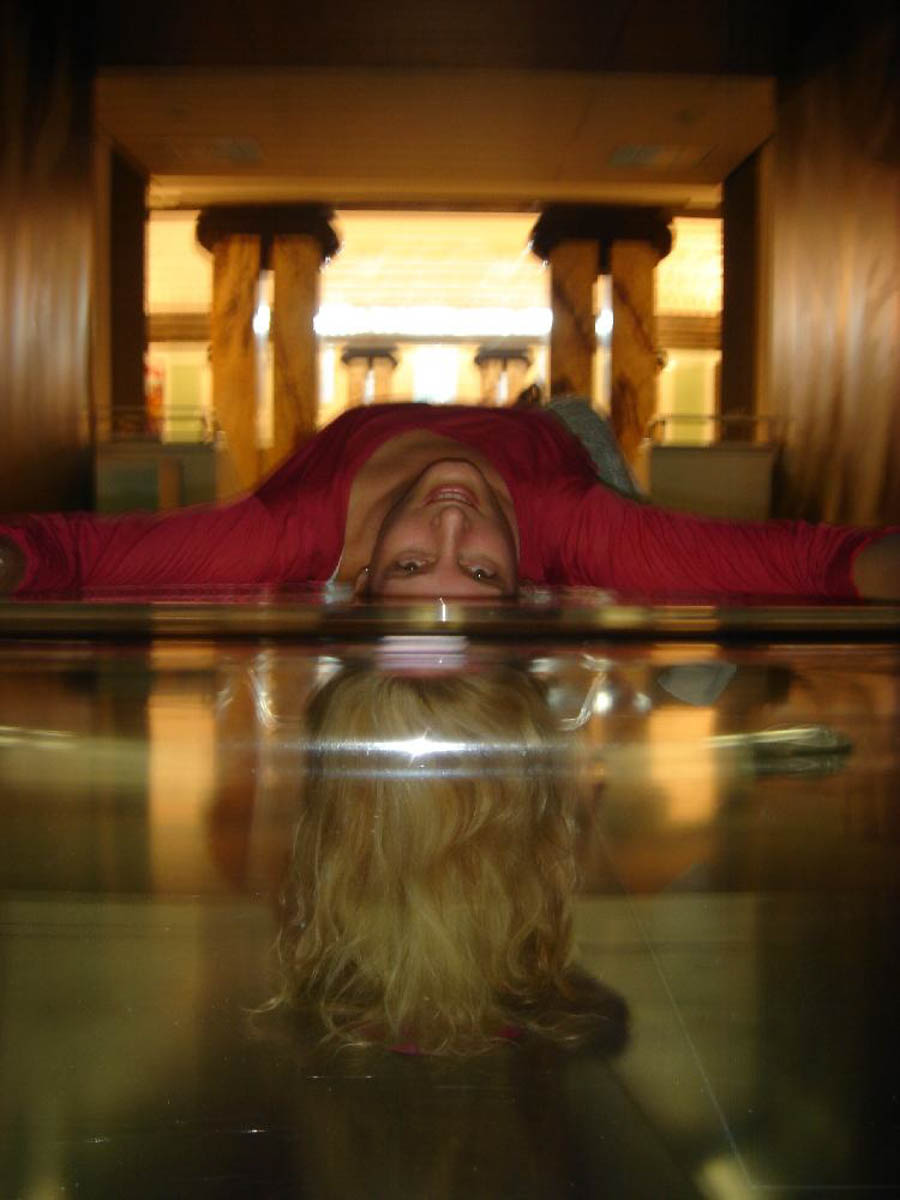
“HHole” consists of several circular openings extending from the floor to the roof of the connecting wing and beyond, positioned vertically one above the other. Together, the openings form a kind of virtual funnel opening up to the sky. Arranged around the openings, which are spread across various exhibition or building levels, are the seven essential spatial installations, each of which is thematically related to the other and each of which also forms a separate work in its own right. In accordance with the wishes of the building inspectors, some openings were sealed with specially manufactured and tested fire-resistant glass. From the lowest level, a special light projector emits a vertically directed beam of light upwards, while daylight penetrates from the attic through the topmost opening. Thus, artificial and natural light interact in the art spaces at certain times of day.
On the one hand, it opens up the architectural-physical boundaries of the museum and the coordinates of social guidelines, and on the other, it connects the reality of art with the reality of nature and the individual.
“HHole” grows from the ground beneath the Kunsthalle like a tree, changing its appearance rhythmically with the seasons and is comparable to a living organism. When visitors stand in the EarthRoom and gaze into the hole in the ground glowing with red light, their imagination sometimes wanders further through the center of the Earth and reappears at the other end of the Earth in the ocean off New Zealand. The initial visit to the EarthRoom is accompanied by the cry of a newborn child. If one views the higher levels of the artwork on a sunny day, for example, the light energy within the museum is magnified. In the evening and at night, “HHole” radiates from itself and with a green laser beam far beyond the museum’s boundaries. The viewer can direct their imagination beyond the museum and the city limits into cosmic worlds.
The concept of “HHole” originates from another work by NatHalie Braun Barends, the so-called “HHouse (for Cirambai),” which the artist designed and built on an island in Brazil between 1998 and 2001. The floor plan of “HHouse” is based on the symbolic figures of “HMap” and “HBeing” and was created in close dialogue with nature. A three-meter-diameter opening was created at the center of the structure to protect the existing trees. Additional circular and geometric openings were developed for trees, lighting, and a connecting tunnel to the sea. “HHouse,” which will become the headquarters of the “HLife Foundation,” now established in New York, was officially recognized as a work of art in 2005. “HHouse” can be viewed online at www.hn2b.com.
“HHole” (for MannHeim) marks the content and aesthetic center of the “Neue Kunsthalle,” which has been positioned as a “living museum” since 2003. It integrates elements of natural origin, those derived from industrial production, or those created as custom-made objects. These include natural media such as earth, water, and light; fixed and movable fixtures; plastic furniture designed by the artist; mirrors; paintings created specifically for the work; photographs; videos; and real-time images from the collection rooms and the sky above the Kunsthalle.
The videos are shown on eight monitors installed in the ceiling of the upper exhibition space. Images depicting the Kunsthalle’s origins, individual works from its collection, and spatial photographs from various historical periods are shown, as well as videos of the work’s development and guided tours of the light installation. Real-time images from the rooms of “HHole” and recordings of a young pianist whose facial expressions were filmed during the creative process of composing are also included.
To the left and right of the video are two video rooms, each providing further information about the light installation. In one room, a video film takes the audience on a tour through the various levels of the artwork. On the walls, viewers can illuminate children’s drawings of “HHole” with flashlights and enjoy the creative interpretations. In the second room, internet access is currently being prepared, allowing visitors to browse the artist’s and artwork’s website, which contains additional data, facts, and photographs, or to take in photographic impressions of the installation on the walls illuminated by flashlights. Finally, in the anteroom, you will find a “HHole Team Ball” with the signatures of the employees involved in the work, a mobile, the diagram of the installation, a mailbox for the work, and a table that invites you to write.
The viewer can become an active participant in the installation in various ways. In addition to a multitude of perceptual experiences, “HHole” also offers the opportunity to embark on journeys of discovery into various content-related and associative levels. For example, they notice that the individual levels of the artwork, as well as those of the adjacent staircase, which is closely connected to the work, are illuminated with different light colors and additionally enriched with various aromas. The distribution of the light colors represents a parallel to the chakra colors, which represent the different parts of the human body. In addition to the aforementioned “primal scream” of a child, which one hears upon entering the Earth Room, one can hear musical interpretations of famous piano pieces by Erika Barends upon opening the gate to the Paradise Room.
The French pianist Douglas Guarneri composed piano pieces for “HHole,” which he titled “Roonstrasse 0,” “HHole Connection,” and “Phoenix for MannHeim.” After giving a concert in Mannheim as part of a Deutsche Bank event, the pianist is currently working on further pieces, which will also all be part of the work.
“HHole (for Mannheim)” is a kind of “microcosmic parallel” that refers in content to the macrocosms of the world and nature, their cyclical laws, and the polar forces manifesting within them. “HHole” has a similarly parallel relationship to the museum as a reference coordinate, reflecting it as a place of collective memory and thereby becoming a place of memory itself.
The multimedia installation, which, in extension of traditional sculpture, can be understood as an “evolving environment,” is primarily accessible through a phenomenologically oriented, spatially and temporally extensive perception. HHole can subtly sharpen the viewer’s senses and their awareness of the experience of space, time, place, context, life, history, and meaning of the museum, conveying art as an experiential category. Both the creation and the ongoing updating of the work are documented on the work’s website, hhole.net.
Visitors can also contact “HHole” by phone at +49 621 44 91 08, leaving questions and suggestions, or even discussing the work with the artist, the director, or the art education staff. It is also possible to call from an installation to other levels and thus engage in conversations with friends or random viewers. Finally, visitors can also write letters to the special address for “HHole” (“HHole”, c/o Kunsthalle Mannheim, Roonstrasse 0, 68165 Mannheim).