


Infinite Room
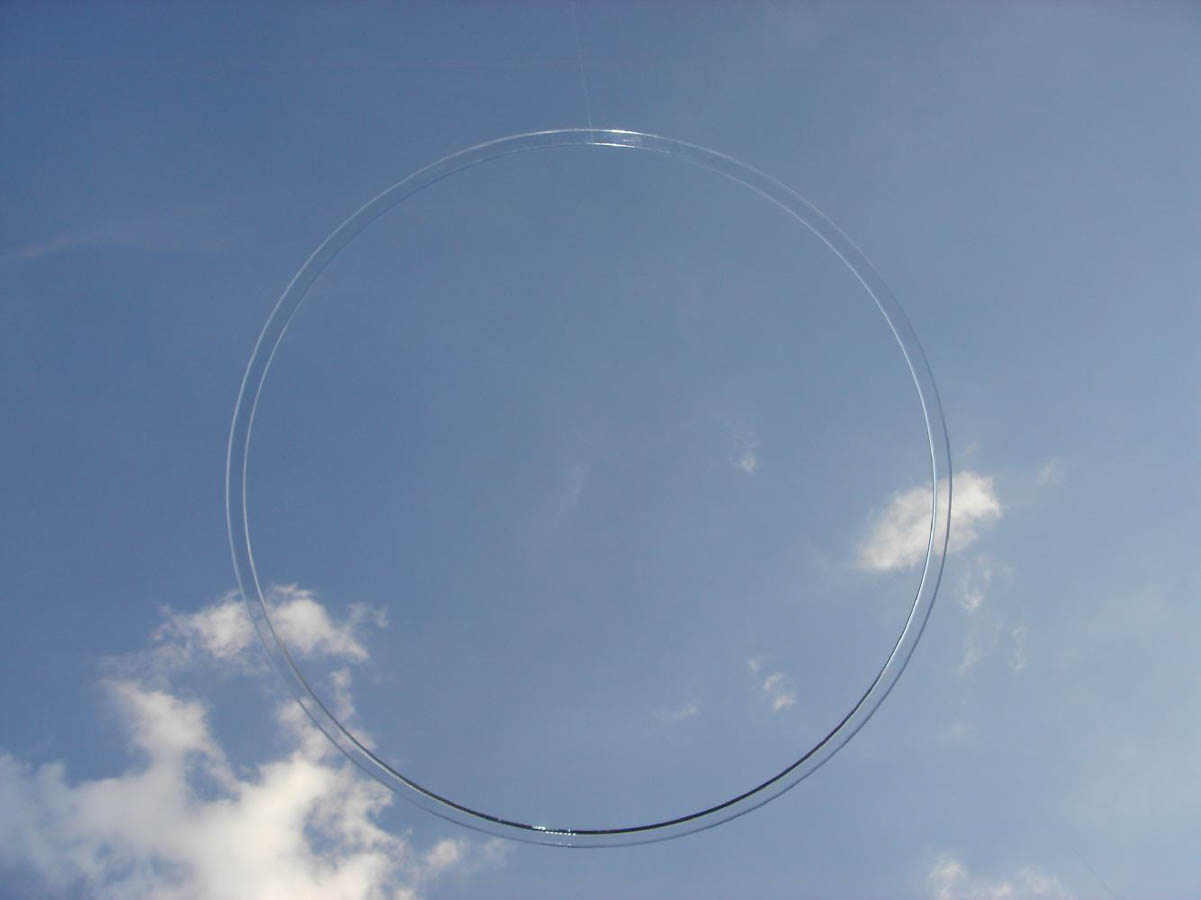
Standing near the entrance to the Phoenix Room and looking up at the sky, one discovers a barely visible transparent plastic ring, a kind of “halo,” symbolically connecting the viewer’s airspace with the sky. This point of contact already hints at the artist’s new light installation, titled “PHaradise,” which explores notions of paradise.
From the Phoenix Room, a staircase leads to a kind of “observation post” from which one can view the entire roofscape of the museum and the large-scale roof installation “HMap” planned for the future. This is the location of a linear angel that shines into the darkness. The angel figure was created by two young people from Paris in collaboration with the artist.
If one finds oneself alone in this space and finds a certain amount of peace, one can follow the beam of light up to the sky and intensely experience the astrological coordinates of the place. A special phenomenon is the optical illusion of the laser beam: No matter where one stands, the laser beam always appears to be above the viewer’s head.
A laser projector is mounted on the narrow side of the roof opening, its fine green beam symbolically transmitting the light of the “H Hole” into the night, the sky, and the cosmos. The infinitely luminous beam is only interrupted on its vertical path into space when it encounters clouds or other horizontally aligned material bodies. With this concentrated beam of light, the Kunsthalle is brought to awareness at night as a particularly energetic and central location in the city. Mannheim’s intellectual and cultural center thus manifests itself as a living organism, active day and night. The viewer’s imagination—provided they embrace the complexity of the artwork’s content—can wander across the cosmos back to New Zealand and from there back to the Kunsthalle, suggesting an endless cycle.




Photos by:
NatHalie Braun Barends
Thomas Henne